

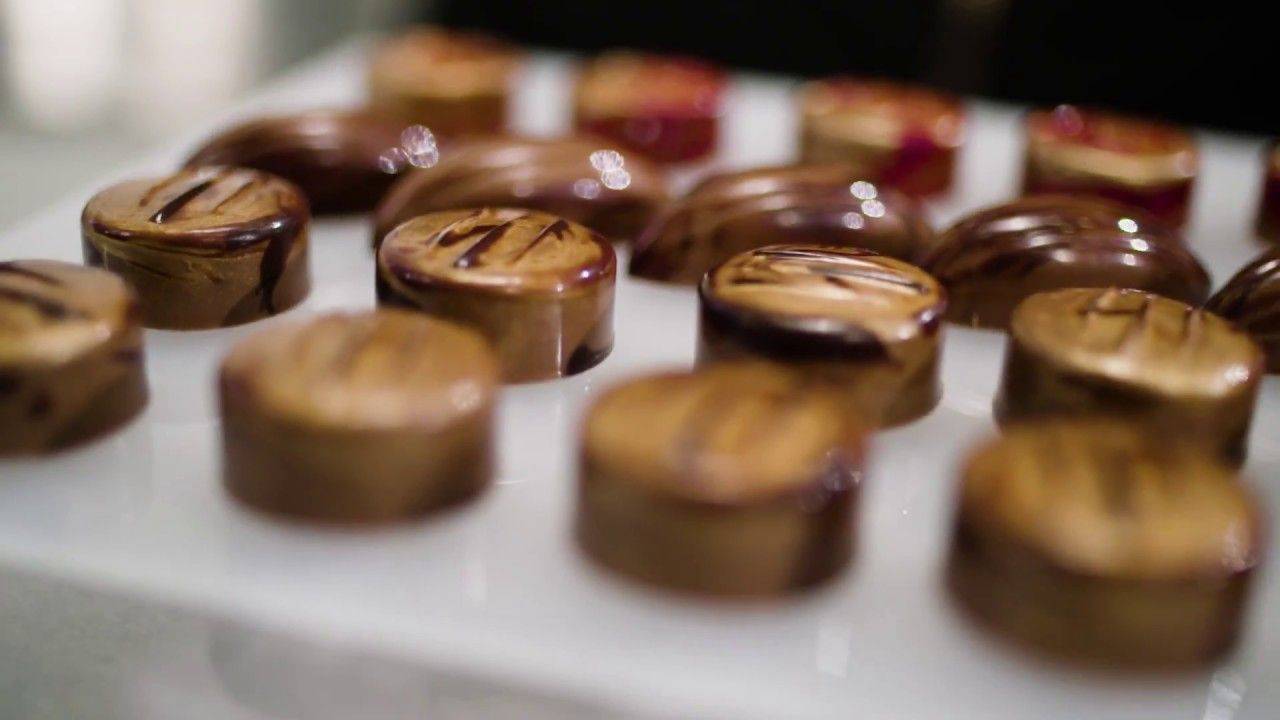
A glaze made with cocoa powder has a very deep dark colour and a sweeter taste than a chocolate-based glaze.
GOOD TO KNOW
What should you take to heart when making a chocolate glaze?
Creating a perfectly balanced chocolate glaze recipe is crucial to obtain impeccable results. It will give the glaze the right texture so it holds up on the cake for at least 2 days.
A perfectly balanced recipe also guarantees the typical mirror-like gloss and appetising deep colour in your chocolate glaze.
Mix the ingredients with a stick blender at low speed in a tall, narrow container. To avoid creating air bubbles, make sure to move your stick blender up and down gently, and to keep its blade under the surface of the liquid at all times.
Respect the cooking temperatures to achieve the perfect glaze thickness: supple enough to be cut without problems, dense enough to hold up on the cake.
To obtain a smooth, lump-free glaze, it is crucial to pass the mixture through a fine sieve after homogenising it with the stick blender.
Store the glaze in a bowl in the refrigerator. Cover your glaze with a sheet of cling film to keep it out of contact with air. It can be stored for about a week.
Before applying on pastries: heat up the glaze to ±35°C. This gives it the ideal fluidity to be applied easily and evenly.
Always apply your chocolate glaze on pastries frozen at exactly -18°C.
Remove your pastries from the grill as soon as the glaze stops dripping, so before it has set. Otherwise, you could tear holes in the glaze.
Glazed pastries can be stored in the freezer at -18°C. When you take them out, store them in the refrigerator at 4°C immediately for at least 2 hours to avoid condensation.
Needed:
550 g water
425 g cream (35%)
250 g glucose syrup
250 g sugar
250 g Callebaut cocoa powder CP
30 g gelatine mass
A high recipient
A spatula
A stick blender
A hotplate
A saucepan
Step 1
Mix together the water, cream, sugar and glucose syrup while heating up the mixture to 105°C.
Step 2
Add the cocoa powder and bring the mixture back to a boil.
Step 3
Pour the mixture through a sieve into a high recipient, which already contains the gelatine mass.
Step 4
Mix everything together gently. Keep the blade of your stick blender below the liquid’s surface at all times to avoid creating air bubbles.
Step 5
Cover the glaze with a sheet of cling film to keep it out of contact with air. Make sure it touches the surface of the mixture.
Step 6
Let the glaze rest in the refrigerator for 24 hours. After that, the glaze is done.
Step 7
Remove the glaze from the refrigerator and heat it up in the microwave to 35°C.
Step 8
Mix the glaze again to give it an even temperature throughout.
Step 9
Take your pastries (which you’ve placed on a grill and frozen at -18°C) from the freezer and apply the glaze immediately.
Step 10
Let the glaze drip for a few minutes. When it has stopped dripping, remove the pastries from the grill and place them on a dessert plate or cake board.
Step 11
Store the remaining glaze in the refrigerator at 4°C. That way, you’ll have it at your disposal whenever you want to finish your other pastries.

Need support with your chocolate confections?
- Find troubleshooting guides & tutorials
Comments
Submitted by Leonardo Argoti on Fri, 03/13/2026 - 04:10
Hey Chef, thanks for sharing. What would the bloom power conversion be if I'm using silver grade gelatin (160bp)? Thanks!
Submitted by Joël on Fri, 03/13/2026 - 11:31
In reply to Hey Chef, thanks for sharing… by Leonardo Argoti
Great question!
When a recipe calls for "gelatine mass" (which is usually a pre-hydrated mixture of 1 part gelatin to 5 parts water), it is typically based on a standard professional bloom strength—usually Gold (200 bloom) or Platinum (230-250 bloom).
Since you are using Silver grade (160 bloom), you'll need to use slightly more gelatin to achieve the same "setting" power.
To keep the math simple, we use the Bloom Strength conversion formula:
Mass_2 = Mass_1 X V--{Bloom_1}/{Bloom_2}}
The ConversionAssuming the original recipe's "30 g gelatine mass" was calculated using Gold gelatin (200 bloom), here is your adjustment for Silver (160 bloom):
- Original Gelatine Mass: 30 g
- Conversion Factor: approximately 1.12x
- Your New Gelatine Mass: 33.6 g
IMPORTANT
To make this 33.6 g of Gelatine Mass using your Silver gelatin, mix 5.6 g of Silver gelatin powder with 28 g of cold water. Let it bloom completely before adding it to your hot glaze.
Why this matters for your Mirror Glaze
- Texture: If you don't adjust for the lower bloom, your glaze might be too "runny" and slide off the sides of your frozen pastry.
- Clarity: Silver gelatin is slightly less "refined" than Gold or Platinum, but in a deep, dark cocoa glaze like this one, it won't affect the visual results at all.
- The "Drip" Test: As the tutorial mentions, wait until the glaze stops dripping before moving the pastry. If you find it’s still too fluid at 35°C, let it cool to 32°C before pouring next time.